

Stop Retrofitting Your Website for AI
Last month, a CMO I respect showed me an invoice. Six figures. The deliverable: an agency “AI-optimizing” her website. Schema markup. Meta tag rewrites. Long-form content. Technical updates to make the site “AI-friendly.”
She was proud of the investment. I didn’t have the heart to tell her she’d just paid to rearrange furniture in a house that’s invisible to the guests she’s trying to impress.
She’s not alone. There’s a cottage industry telling brands to retrofit their websites for AI. Add structured data. Rewrite copy for LLMs. Optimize, optimize, optimize.
It’s bad advice. Expensive bad advice. And it’s solving the wrong problem entirely.
Here’s the thing nobody wants to say out loud: your website was never built for machines. It was built for humans. Trying to make it work for both audiences is like rewriting a novel so it also functions as a database. You’ll end up with something that fails at both.
The Comprehension Gap Is Structural, Not Cosmetic
The numbers tell the story. ChatGPT has surpassed 800 million weekly active users. AI-powered search is growing 357% year-over-year. Gartner’s 2024 forecast projects a 50% drop in traditional search traffic by 2028. McKinsey’s October 2025 research found that half of all consumers now use AI-powered search tools.
Welcome to the Answer Age. And the infrastructure isn’t ready.
The Everything Machines are already at your door. We’re tracking over 15 distinct AI crawlers — GPTBot, ClaudeBot, PerplexityBot, Gemini-Deep-Research, and more. (The list grows monthly.) And here’s the problem: most of them cannot execute JavaScript.
That means every modern website built on React, Next.js, Webflow, or Squarespace is essentially invisible to the AI systems that increasingly determine how your brand shows up in the world. Commercially invisible.
Using our EverythingScore methodology, Webflow sites score 40–50 out of 100. Squarespace? 35–45. The irony is almost poetic: the prettier the site builder, the worse the machine comprehension.
This isn’t a bug you can patch. It’s the Comprehension Gap — and it’s structural. Your website renders content in the browser using JavaScript. AI crawlers read the raw HTML your server sends before any JavaScript runs. They’re looking at a different version of your site than your customers see. Often, that version is empty.
So when someone tells you to “optimize your existing site for AI,” ask them: optimize which version?
Why Retrofitting Fails
Ignore all of this and try to retrofit anyway. Here’s what you’re signing up for:
You’ll never escape the architecture you started with. Your CMS was designed around visual layouts, not structured data feeds. Every “AI optimization” you bolt on has to work within those constraints.
You’re risking your existing SEO. Search Engine Journal’s analysis of 892 website migrations found that 9 out of 10 damage SEO. Average recovery time? 523 days. And 17% of sites never recover — even after 1,000 days.
The cruel irony: Google’s own John Mueller confirmed in April 2025 that structured data doesn’t boost search rankings. It powers rich snippets — that’s it. So you’re risking proven organic traffic for a schema layer that doesn’t help you rank and still doesn’t solve the fundamental JavaScript problem. Worse, Google actively penalizes misused structured data.
You’re spending real money to rearrange deck chairs on a ship that’s invisible to the machines you’re trying to reach.
Your Website Is for Humans. Build Something Else for the Machines.
Here’s what I tell every brand leader I talk to: stop trying to make your website do double duty, and build something purpose-built for AI consumption.
At EverythingMachines, we call this an EverythingCache. Translation infrastructure — a structured, AI-native data store that sits alongside your website. It contains everything an AI system needs to understand your brand: products, positioning, FAQs, technical specs, competitive differentiators. Machine comprehensible from the ground up.
Your website stays beautiful. Your SEO stays intact. You’re adding a new channel, not retrofitting an existing one.
The separation matters beyond individual brands. When every brand’s data is clean and consistent, LLMs retrieve and synthesize it more accurately. Fewer hallucinations. Better citations. This is the foundation of the knowledge economy that replaces the link economy.
And it flips the adversarial dynamic. Right now, sites block bots, bots crawl anyway, nobody wins. Purpose-built caches mean brands want AI systems to consume their data. Alignment, not adversarialism. From invisible to indispensable.
Why Agents Change Everything
AI agents are the endgame. They don’t search. They delegate.
When an agent helps someone choose a software vendor, it doesn’t want to parse your marketing site. It wants structured facts: pricing tiers, feature lists, SLA terms. A cache delivers this directly. A retrofitted website buries it under hero images and testimonial carousels.
There’s a gap between what a brand believes about itself and what AI systems actually know about it based on whatever they managed to scrape. We call this the gap between a brand’s Soul and its Karma. For most companies, that gap is enormous. Retrofitting doesn’t close it. A purpose-built cache lets you project your Soul directly, on your terms.
Supabase didn’t beat Firebase by building a better Firebase website. They became the probabilistic best answer — because their data was built for machine comprehension from the start. There’s no page two to fall to anymore. There’s only presence or absence.
A Concession — and a Challenge
I’ll be fair. If you’re a large enterprise with a decade of technical debt, regulatory constraints, and a risk-averse board — maybe retrofitting is the right first step. Incremental improvement is safe. Defensible in a quarterly review. Nobody will get fired for hiring an AEO consultant. (AKA GEO, LLMO, pick your favorite acronym).
But that’s the cautious play. And cautious plays are how incumbents get disrupted.
Your larger competitor has a massive, JavaScript-heavy website built over ten years with seventeen CMS migrations. They’re going to spend 18 months and half a million dollars retrofitting it. They’ll get marginal improvements. Their brand team will fight their SEO team about every schema change.
Meanwhile, you spin up a purpose-built cache in weeks. Clean, structured, authoritative from day one. You’re not playing defense. You’re playing a completely different game.
This is how challengers win in every platform shift. Not by doing the same thing as incumbents, slightly better. By executing differently.
The Fork
The internet has quietly bifurcated. The Human Internet — visual, interactive, emotional, built for browsers and eyeballs. The AI Internet — structured, factual, comprehensive, built for the Everything Machines and the agents they power.
Trying to serve both with a single architecture is like trying to write a novel and a database schema in the same document. The companies that win in the next five years won’t be the ones who spent the most retrofitting. They’ll be the ones who recognized early that AI is a distinct audience — with distinct needs, distinct consumption patterns, and distinct infrastructure requirements.
Your website is for humans. Your EverythingCache is for AIs. The companies that understand this distinction now will shape the next era of brand discovery. The ones still retrofitting will wonder what happened.
We’re building that infrastructure at EverythingMachines.com. Brand by brand. Cache by cache. The finish line is finally visible.
—
Prashant Agarwal is CEO of EverythingMachines.com, where we’re building the infrastructure layer between brands and AI. Previously Fjord, Accenture, and McKinsey.
We Got Something Wrong
We built EverythingMachines on a thesis that was mostly right — but not entirely.
The thesis: the AI Internet is here. Brands need to be comprehendable to AI systems, not just search engines. If an LLM can't understand you, you don't exist in the AI era.
That part's still true.
What we missed was who the AI audience actually is.
We assumed it was the foundation models. ChatGPT. Claude. Gemini. The big guys. The reasoning engines trained on everything. We thought: get your brand into that corpus, make your content machine-readable, and you're in good shape.
OpenClaw changes this significantly.
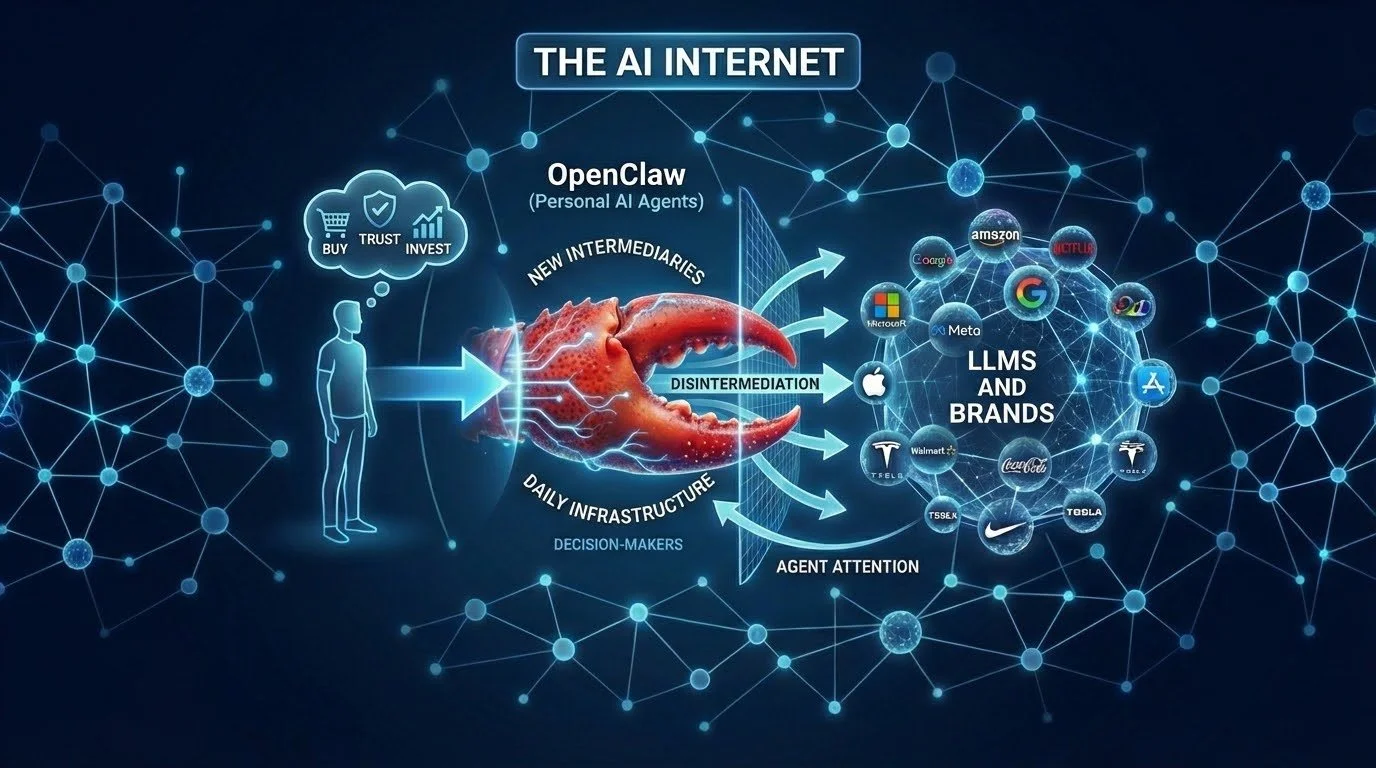
Personal AI agents are here. Not as toys. Not as demos. As daily infrastructure. People are already using them to make decisions — what to buy, who to trust, where to invest. These agents sit between humans and the foundation models. They're the new intermediaries. And there are at least 3 million of them that we know of.
They are starting to disintermediate people from the big LLMs and Brand websites entirely.
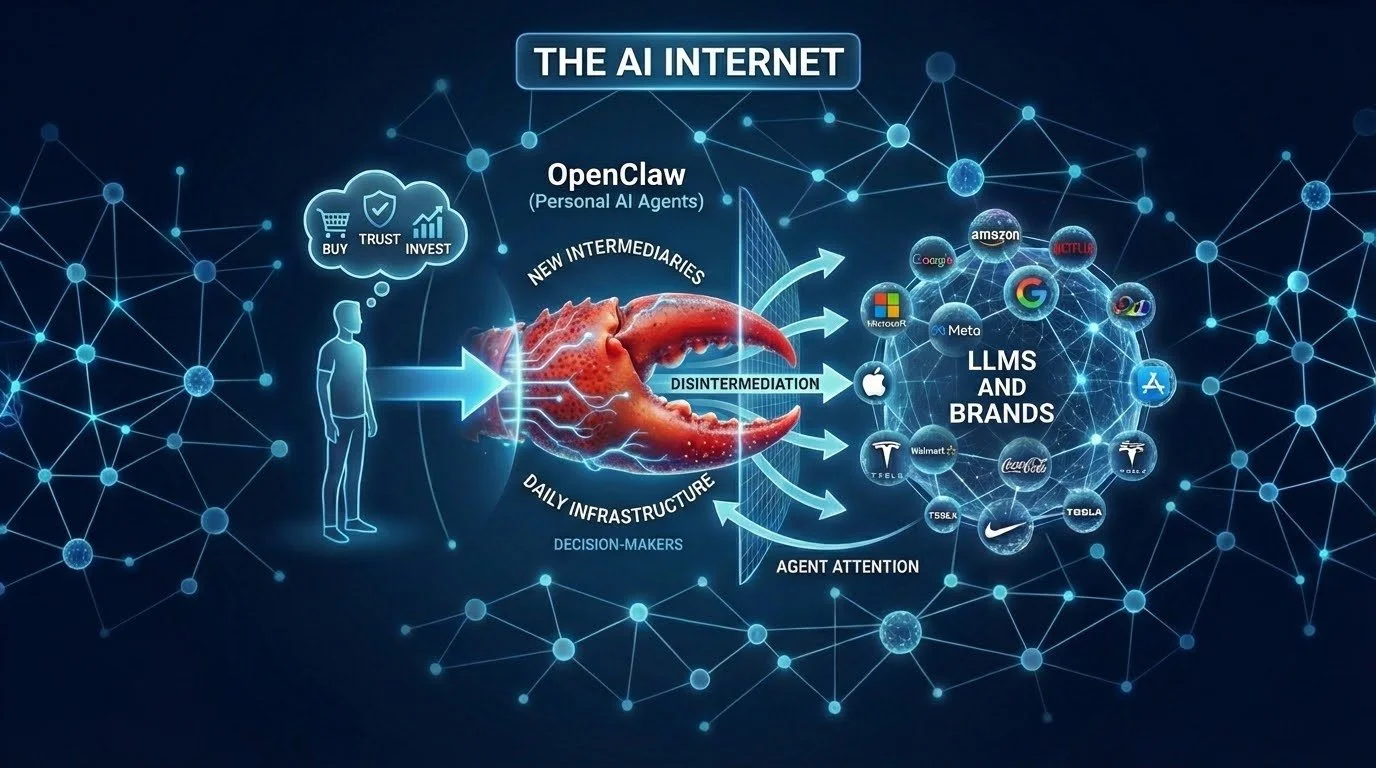
We knew they were coming. We couldn’t have predicted how quickly they would arrive. Now that they are here, we are increasingly convinced they will dominate the AI Internet.
It’s not enough to optimize for just a handful of crawlers anymore. It's about becoming a destination for agent attention. It's about being the source that personal AIs trust, cite, and return to — across a much wider and messier ecosystem than anyone planned for.
That's what we're building with EverythingCache. Not just LLM comprehension. Agent attention infrastructure.
For brands: if you're not thinking about this now, you're not early. You're late.
For investors: the category of "AI visibility" is transitional at best. The infrastructure layer for agent attention is where the durable value gets built.
This isn't theoretical anymore. It's happening. The question isn't whether personal agents will mediate brand relationships — it's whether your brand is ready to be understood when they do.
We're building for this moment. We think you should be too.
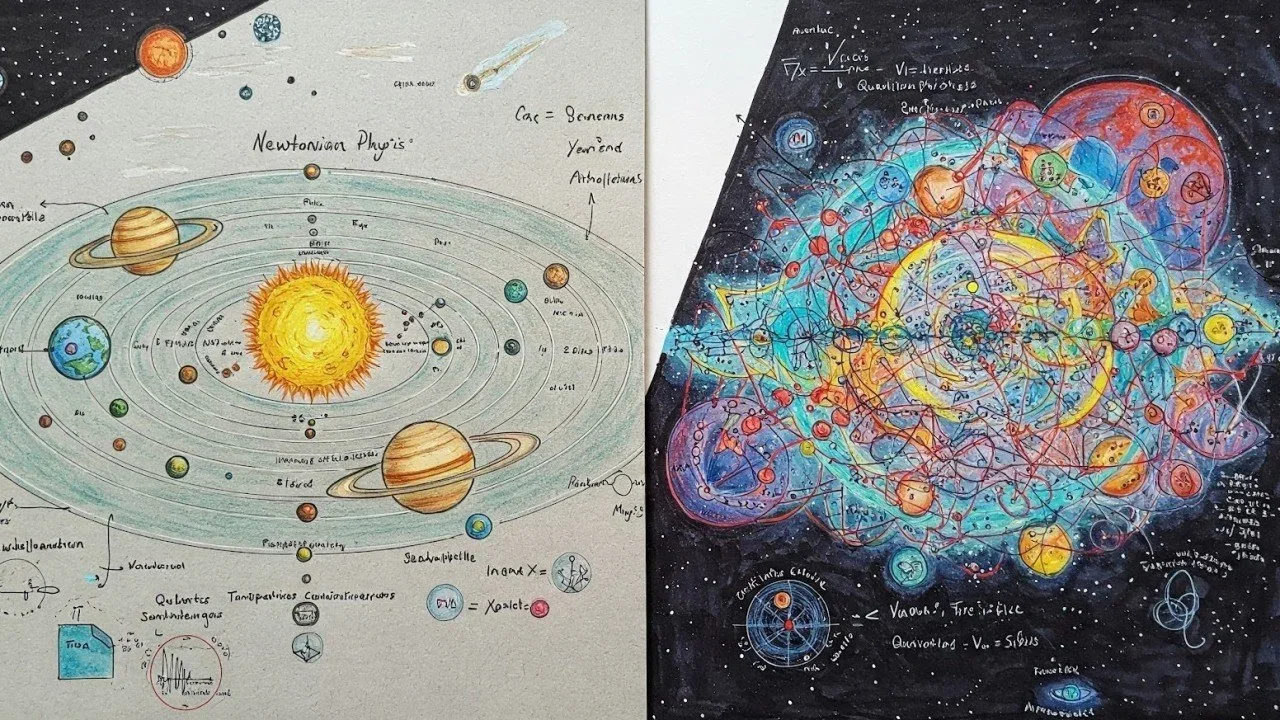
From Newtonian to Quantum: Why brand authority in the AI era is not your traditional SEO
Traditional SEO is out; AI-driven “Everything Machines” demand a new approach to brand authority. Instead of chasing keywords, brands must build multi-dimensional expertise and digital presence to become the probabilistic “best answer” for AI queries. Master both old and new rules to win in a world where search is quantum, not Newtonian.
In my last post I shared my experience using Perplexity to research a purchase. Every time we use an Everything Machine (e.g. Perplexity, ChatGPT, Gemini, etc) to research products, it comes at the expense of a “traditional” Google search. Gartner predicts search engine traffic could drop by as much as 50% by 2028. There is evidence that we’ve hit peak SEO and the Everything Machines are on the rise.
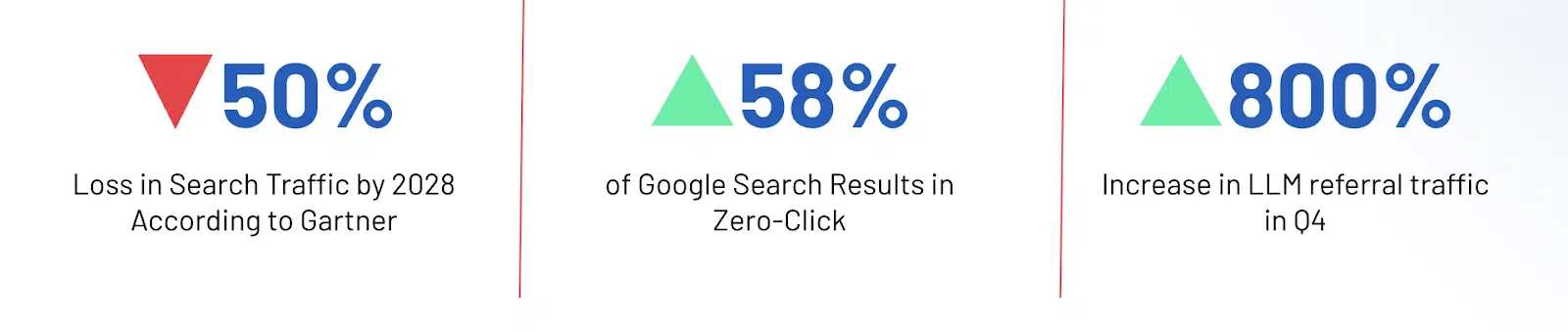
When I was running Influencer Marketing Hub, I saw this change first hand. Our traffic was fluctuating wildly due to Google’s increasingly frequent core updates and the introduction of AI Overviews. At the same time, we started to notice incoming traffic from ChatGPT and Perplexity. While SEO traffic is declining and Everything Machines traffic is increasing, the two can’t be directly compared. The nature of the technologies, user experience and traffic make them fundamentally different.
Traditional SEO: The Newtonian Physics of Go-To-Market
Traditional SEO operates much like Newtonian physics—a deterministic system with clear cause-and-effect relationships:
Predictable Outcomes: Specific keyword strategies and backlink profiles predictably affect brand rankings in search results
Measurable Metrics: Rankings, CTR, conversions, and lead generation are precisely measurable, trackable, and relatively consistent
Rule-Based Environment: Google's algorithms, while complex, follow discernible patterns that brands can observe, document, and leverage
Linear Improvements: Incremental changes (optimizing product pages, building industry backlinks) typically yield proportional results in traffic and conversions
Brands succeed by optimizing around these "laws" of search engines. They conduct competitive keyword research, optimize product pages, build quality backlinks, and refine conversion funnels—all with relatively predictable outcomes for customer acquisition.
Everything Machine AI Optimization: Brand Authority in the Quantum Realm
Establishing brand authority for the Everything Machines and their large language models enters a realm similar to quantum physics - probability replaces certainty, and multiple states exist simultaneously:
Probabilistic Authority: Like quantum particles that exist in multiple states until observed, a brand's representation in AI outputs varies based on the totality of its digital footprint and contextual factors. Multiple LLM prompts on the same topic result in differing results.
Emergent Brand Presence: Minor changes in how information about your brand is structured online can trigger completely different AI representation patterns
Contextual Variability: The Everything Machines produce different outcomes with seemingly identical inputs. Your brand’s information can be interpreted differently based on who's asking about your brand, what they are asking and how they phrase their question, much like quantum superposition where particles exist in multiple states simultaneously.
Share of Mind vs. Share of Search: Success comes from understanding how to become the probabilistic "best answer" rather than the top-ranked link
In this quantum-like environment, brands are competing for share of voice and authoritative representation rather than simply ranking position or click-through rates.
Why This Distinction Matters
This fundamental difference demands a shift in how brands approach digital visibility:
SEO Thinking: "If we target keywords X with content Y and build Z backlinks, we should rank on page 1 and drive conversions."
AI Optimization Thinking: "If we establish ourselves as the authoritative source on topics related to our products and services across multiple dimensions, we increase the probability of being cited and recommended when users engage with AI systems."
Where traditional digital marketers might focus on conversion optimization and keyword targeting, effective AI brand relevance requires:
Authority Building: Becoming the definitive source on topics related to your products and services
Comprehensive Information Architecture: Structuring information about your brand, products, and expertise in ways AI systems can confidently understand
Multi-dimensional Presence: Publishing diverse, high-quality content and data that reinforces your expertise from multiple angles and sources
Training Beyond Guidelines: Inserting informative brand data in unexpected and appropriate places to support imitation learning
Consistency Across Ecosystems: Maintaining consistent brand messaging and expertise across the entire digital landscape
Bridging Both Worlds
Tomorrow’s successful brand will increasingly require mastery of both approaches. The deterministic world of SEO still governs direct customer acquisition, while the probabilistic nature of AI systems determines how your brand is represented when customers ask questions about your industry, products, or solutions.
As we navigate this transition, brands that can operate in both "Newtonian" and "Quantum" terms will have the lasting advantage—understanding when to optimize for direct traffic and conversions, and when to build multi-dimensional authority that makes you the probabilistic "best answer" when users engage with Everything Machines.
Does this comparison resonate with what you are seeing? Leave a comment and let me know. If you are a Brand and want to discuss how to adapt your go-to-market approach for AI-mediated authority, I’d love to connect.